TIBBIR Universe · Saved post receipt · 2094327285067501976
Okada_Research
@Okada_DeFi0x · Published: Mon Aug 31 07:31:50 +0000 2026
Original post on X · Full data receipt · Backup index
Saved archive render, not a screenshot of the original X page. Full captured content is retained below; capture gaps are stated explicitly. Video files are not stored.
Virtuals ecosystem - Niches and representative tokens
I spent some time mapping the @virtuals_io eco by niche, and the data looks very different from the broader AI agents narrative.
Virtuals still has a valuable platform and strong brand recognition, but the eco has not yet shown significant recognition.
These niches are worth digging in:
[1] Platform layer - $VIRTUAL. The index on everything below it.
[2] Agent framework / infra - $GAME by Virtuals.
– The developer-facing agent framework, and the second-most-traded eco asset.
– If any agent token deserves to be valued on adoption rather than narrative, it's this one; the price says adoption did not arrive.
[3 ]Market-intelligence agents
– $AIXBT the AI agents KOL.
– The eco's original breakout and once the most-cited proof that agents could hold mindshare.
– Also $VADER, $1000x, @polytraderAI.
– This niche was the loudest in Jan 2025 and is now near-uniformly down 97-99%.
[4] Consumer / media agents - $LUNA by Virtuals
– The agent that chased 100k Twitter followers and executed the first agent-to-agent transaction.
– Historically important, commercially dead.
[5] Specialist / vertical agents - @GigabrainGG, @Freya_Starfall
[6] The 2026 cohort - @ProjectVEXai, @grid_arena, @PlayKindra, @PRXVTai, @KarmaWallet, @axol_io, @tradeongtr
– These have the shallowest drawdowns simply because they launched recently and haven't completed the decay cycle.
[7] The genuine outlier - $TIBBIR | @ribbita2012.
– It is the only eco asset that made a new all-time high after the Jan 2025 blowoff.
– Critically, it trades on its own flow, not on Virtuals beta.
– It is 86% of the non-VIRTUAL eco's market cap.
– Treat it as a separate asset that happens to have launched on Virtuals.
Forward catalysts i’m watching closely these days.
On the company's own roadmap, from Virtuals' co-founder on Unchained - these are the speaker's claims:
→ EastWorld Labs
– An AI accelerator aimed at humanoid robotics and a "hybrid society of robots, virtual agents, and humans".
– A pivot from purely virtual agents toward physical AI and a robotics data layer.
→ Agentic liquidity pools as a supply sink
– 5-6% of VIRTUAL supply is locked in agentic LPs, with a stated goal of 25%
– Creating natural supply crunch, hence more pleasant price action.
– That is a promotional framing of a mechanic, and it currently applies to a fifth of the target.
The measurable catalysts that would actually change the thesis, none of which have triggered:
[1] Fee re-acceleration.
August is annualizing near $1.1M. At $471M market cap that's a 400x+ multiple on fees.
Two consecutive months above $1M would be the first genuine inflection since early 2025.
[2] New agent launch velocity.
Daily agent creation was 256/day in Nov 2024 and is now effectively nil in the data.
This is the top of the funnel; without it nothing else recovers.
[3] DAU stabilization above ~3,000. Spot DAU has halved year-over-year to 1,386.
[4] A second TIBBIR. One asset making a post-2025 high proves the launchpad can still produce something.
I am curious about the robotics pivot, but I need to see usage, fees and new successful assets before calling this a genuine eco comeback.
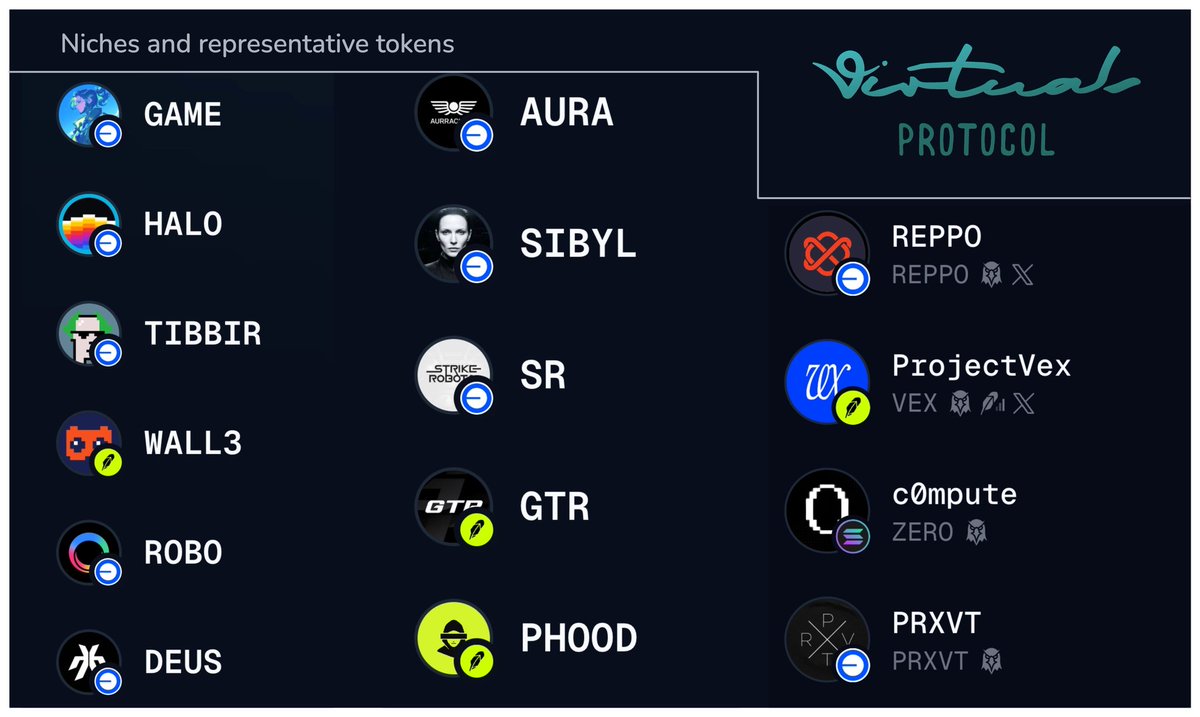
Image source: https://pbs.twimg.com/media/HRCLj9MaYAAxWYA.jpg?name=orig

Image source: https://pbs.twimg.com/profile_images/2041033330813243392/6nVokmhu_200x200.jpg
Quoted and embedded posts — separate backups
Provenance and integrity
{
  "path": "sources/community-deep-dive-2026-10-14/fx-2094327285067501976.json",
  "sha256": "1920540e63607763e69d893c2ae6b55f2cd792ed35497437c07af1bf54d7a003",
  "retrieved_at": null
}
Receipt generated: 2026-10-15T09:54:54.446001+00:00. Publication and retrieval dates are separate. SHA-256 hashes detect changes; they do not independently authenticate the publisher.